
The Difference Between Precision and Accuracy
When it comes to measurements and data, precision and accuracy are two crucial concepts that are often misunderstood or used interchangeably. However, they have distinct meanings and play different roles in determining the quality of a measurement.
Precision
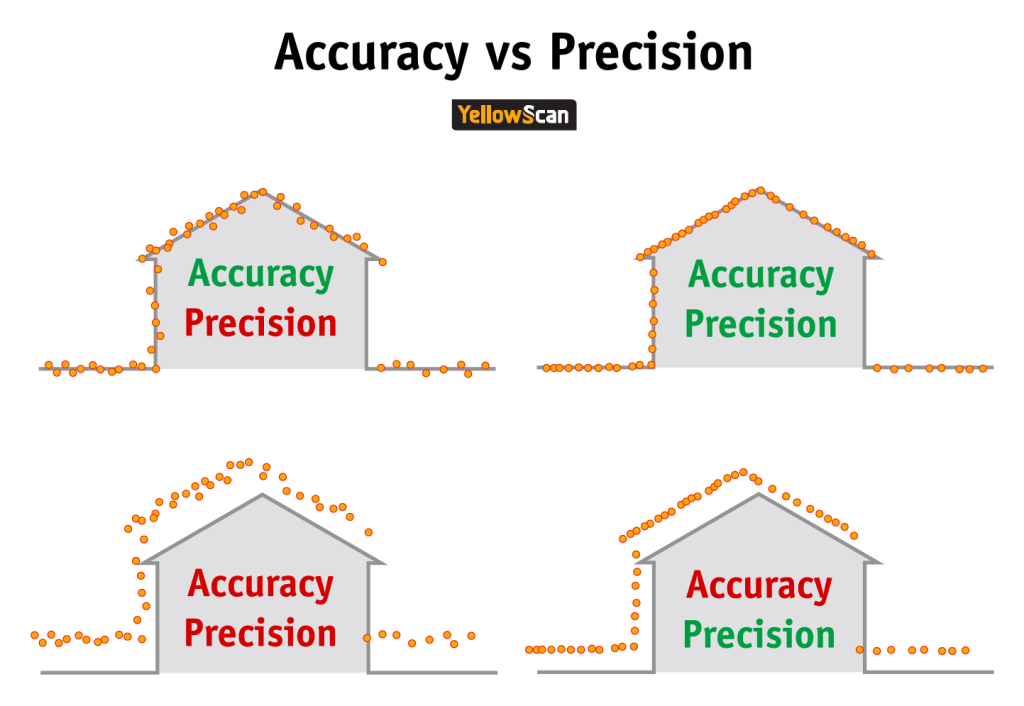
Precision refers to the level of consistency or repeatability in obtaining the same result when the measurement is repeated multiple times. In other words, a precise measurement will yield similar results each time it is taken, even if those results are not necessarily close to the true value.
Accuracy
Accuracy, on the other hand, describes how close a measured value is to the true or accepted value. An accurate measurement indicates that the result is near the target or desired value, regardless of whether it is consistently reproduced.
Understanding the Relationship
It is possible for a measurement to be precise but not accurate. For example, if a set of measurements consistently cluster around a particular value but that value is far from the true value, it demonstrates precision without accuracy.
Conversely, a measurement can be accurate but not precise. This situation occurs when repeated measurements yield values that are all close to the true value but vary widely from each other. While these measurements are accurate on average, they lack precision due to their inconsistency.
Importance in Various Fields
The concepts of precision and accuracy are vital in scientific research, engineering, manufacturing, healthcare, and many other fields where reliable measurements are essential. Understanding and controlling both precision and accuracy ensure that data collected is meaningful and useful for decision-making processes.
In conclusion, precision focuses on consistency and reproducibility, while accuracy emphasises closeness to the true value. By recognising and appreciating these distinctions, professionals can improve the quality of their work by producing reliable and trustworthy results.
Understanding Precision and Accuracy: 8 Essential Tips for Reliable Measurements
- Precision vs. Accuracy
- Precision refers to how close measurements are to each other, while accuracy refers to how close measurements are to the true value.
- High precision means that repeated measurements will be very similar, regardless of accuracy.
- High accuracy means that measurements are close to the true value, regardless of whether they are precise or not.
- A measurement can be precise but not accurate if it consistently misses the true value by the same amount.
- To improve precision, focus on reducing random errors such as variations in experimental conditions or equipment limitations.
- To improve accuracy, focus on reducing systematic errors such as calibration issues or faulty equipment.
- It is important to consider both precision and accuracy when evaluating the reliability of data.
Precision vs. Accuracy
When distinguishing between precision and accuracy, it is essential to recognise that precision relates to the consistency and repeatability of measurements, while accuracy pertains to how close a measured value is to the true or accepted value. Understanding this subtle yet critical difference is crucial in various fields, as it ensures that data collected is not only consistent but also reliable and reflective of the actual target value. By grasping the nuances of precision versus accuracy, professionals can enhance the quality and validity of their work, leading to more informed decision-making processes.
Precision refers to how close measurements are to each other, while accuracy refers to how close measurements are to the true value.
In the realm of measurements, the distinction between precision and accuracy is crucial for obtaining reliable and meaningful data. Precision relates to the consistency and proximity of multiple measurements to each other, highlighting the repeatability of results. On the other hand, accuracy focuses on the proximity of measurements to the true or target value, indicating how closely they align with the actual quantity being measured. Understanding and applying these concepts effectively can lead to enhanced quality control and decision-making processes across various disciplines.
High precision means that repeated measurements will be very similar, regardless of accuracy.
In the realm of measurements, the concept of high precision signifies that when a measurement is taken multiple times, the results will exhibit minimal variation or deviation from each other. This emphasis on consistency and repeatability highlights the reliability and stability of the measurement process, irrespective of its proximity to the true value or accuracy. High precision ensures that data points cluster closely together, providing a clear indication of the measurement’s consistency and reproducibility over time.
High accuracy means that measurements are close to the true value, regardless of whether they are precise or not.
In the realm of measurements, achieving high accuracy signifies that the obtained values are in close proximity to the true or accepted value, irrespective of their precision levels. This distinction highlights the importance of accuracy in ensuring that the measured results align closely with the intended target, even if there may be variations in consistency or repeatability. Striving for high accuracy not only enhances the reliability and trustworthiness of data but also underscores the significance of capturing values that reflect real-world conditions with minimal deviation from reality.
A measurement can be precise but not accurate if it consistently misses the true value by the same amount.
In the realm of measurements, it is essential to grasp the nuanced relationship between precision and accuracy. A measurement can exhibit precision without accuracy when it consistently deviates from the true value by a fixed amount. This scenario highlights the importance of not only achieving consistent and reproducible results but also ensuring that those results are close to the intended target. Understanding this distinction is key to refining measurement techniques and enhancing the reliability of data analysis across various fields of study and application.
To improve precision, focus on reducing random errors such as variations in experimental conditions or equipment limitations.
To enhance precision in measurements, it is essential to address random errors that can arise from fluctuations in experimental conditions or limitations of the equipment being used. By minimising these unpredictable factors, such as maintaining consistent environmental settings and calibrating instruments regularly, researchers can increase the reliability and consistency of their data. This attention to detail not only improves the precision of measurements but also lays a solid foundation for achieving accurate results in scientific experiments and analyses.
To improve accuracy, focus on reducing systematic errors such as calibration issues or faulty equipment.
To enhance accuracy in measurements, it is essential to address and mitigate systematic errors that can arise from factors such as calibration issues or faulty equipment. By identifying and rectifying these sources of error, practitioners can ensure that their measurements align more closely with the true values they intend to capture. This proactive approach not only enhances the reliability of data but also contributes to the overall quality and integrity of the results obtained.
It is important to consider both precision and accuracy when evaluating the reliability of data.
When evaluating the reliability of data, it is crucial to take into account both precision and accuracy. Precision ensures the consistency and repeatability of measurements, indicating how closely individual results align with each other. On the other hand, accuracy measures how close the average of these results is to the true value or target. By considering both precision and accuracy together, one can gain a comprehensive understanding of the quality and trustworthiness of the data being analysed. Only by assessing these two factors in tandem can we make informed decisions based on reliable information.