
The Difference Between Precision and Accuracy
When it comes to measurements and data analysis, precision and accuracy are two crucial concepts that are often misunderstood. While they both relate to the quality of a measurement, they have distinct meanings and implications.
Precision
Precision refers to the level of consistency or repeatability in a set of measurements. A measurement is considered precise if repeated measurements under the same conditions yield similar results. In other words, precision is about how close the measured values are to each other.
Accuracy
Accuracy, on the other hand, describes how close a measured value is to the true or accepted value. It reflects the degree of correctness in a measurement. An accurate measurement is one that is close to the true value, regardless of whether it is consistent with other measurements.
Example:
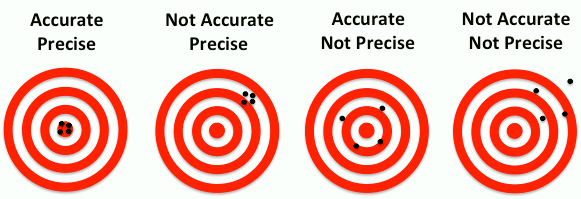
Imagine a target board with multiple arrows hitting different spots on the board. If all arrows hit close to each other but far from the center of the target, those shots are precise but not accurate. Conversely, if all arrows hit near the center but are spread out from each other, those shots are accurate but not precise.
In practical terms, achieving both precision and accuracy in measurements is ideal. However, it’s essential to understand that a measurement can be precise without being accurate and vice versa.
By comprehending the distinction between precision and accuracy, researchers, scientists, and professionals can make informed decisions when interpreting data and drawing conclusions based on measurements.
Understanding Precision vs Accuracy: Definitions, Examples, and Their Importance in Scientific Research
- What is the difference between precision and accuracy?
- How do you define precision in measurements?
- What does accuracy mean in the context of data analysis?
- Can you provide an example of a precise measurement that is not accurate?
- Give an example of an accurate measurement that lacks precision.
- Why is it important to distinguish between precision and accuracy in scientific research?
- How can one achieve both precision and accuracy in measurements?
- What implications do errors in precision and accuracy have on experimental results?
What is the difference between precision and accuracy?
The difference between precision and accuracy is a common question that arises in various fields, especially in measurements and data analysis. Precision refers to the consistency and repeatability of measurements, indicating how closely multiple measurements agree with each other. On the other hand, accuracy relates to how close a measured value is to the true or accepted value, regardless of whether the measurements are consistent with each other. To illustrate this difference, consider a dart player aiming at a target board. If all darts hit close to each other but away from the bullseye, they are precise but not accurate. Conversely, if all darts hit near the bullseye but are spread out from each other, they are accurate but not precise. Understanding this distinction is crucial for ensuring reliable and meaningful results in various scientific and practical applications.
How do you define precision in measurements?
Precision in measurements refers to the level of consistency or repeatability in a set of measured values. It indicates how closely individual measurements agree with each other when taken under the same conditions. In simpler terms, precision is about the degree of exactness and reliability in a series of measurements. For example, if a scientist measures the length of a table multiple times and consistently gets very similar results, then those measurements are considered precise. Precision helps assess the reliability and reproducibility of data, allowing researchers to gauge the consistency of their experimental outcomes.
What does accuracy mean in the context of data analysis?
In the context of data analysis, accuracy refers to how close a measured or calculated value is to the true or expected value. It reflects the degree of correctness in the data analysis process. For example, if a weather forecasting model predicts that the temperature will be 25 degrees Celsius for a particular day, and the actual recorded temperature turns out to be 24.5 degrees Celsius, then the accuracy of the forecast is high. Accuracy in data analysis is crucial for making reliable decisions and drawing meaningful conclusions based on the information provided by the data. It ensures that the results obtained are trustworthy and align closely with reality, thus enhancing the credibility and utility of the analysis outcomes.
Can you provide an example of a precise measurement that is not accurate?
A common question that arises when discussing the difference between precision and accuracy is whether a measurement can be precise without being accurate. An example of this scenario can be seen in a situation where a scale consistently shows a weight of 4.9 grams for a standard 5-gram weight. In this case, the measurements are precise because they are consistently close to each other (4.9 grams), indicating a high level of precision. However, since the measured value deviates from the true weight of 5 grams, it is not accurate. This example highlights how precision and accuracy are distinct concepts in measurement analysis, with precision focusing on consistency and accuracy on closeness to the true value.
Give an example of an accurate measurement that lacks precision.
An example of an accurate measurement that lacks precision can be seen in a scenario where a weighing scale consistently reads 100 grams for an object that actually weighs 98.2 grams. Despite consistently providing the accurate value of 100 grams, the scale’s lack of precision is evident as it fails to reflect the slight variations in weight that may be crucial in certain contexts, such as scientific experiments or quality control processes. This example highlights how accuracy alone does not guarantee precision, emphasising the importance of considering both aspects when evaluating the reliability of measurements.
Why is it important to distinguish between precision and accuracy in scientific research?
In scientific research, it is crucial to distinguish between precision and accuracy as they play distinct roles in ensuring the reliability and validity of experimental results. Precision helps researchers assess the consistency and reproducibility of measurements, allowing them to determine the level of random errors present in their data. On the other hand, accuracy is essential for evaluating how close experimental values are to the true values, providing insights into systematic errors that may affect the validity of conclusions drawn from the research. By understanding and differentiating between precision and accuracy, scientists can make informed decisions about the quality of their data, identify areas for improvement in experimental procedures, and enhance the overall robustness of their findings. For instance, in pharmaceutical research, distinguishing between precise dosage measurements (precision) and accurately determining a drug’s effectiveness (accuracy) can have significant implications for patient safety and treatment outcomes.
How can one achieve both precision and accuracy in measurements?
To achieve both precision and accuracy in measurements, it is crucial to focus on two key aspects: reducing systematic errors to improve accuracy and minimizing random errors to enhance precision. Systematic errors, which lead to inaccuracies in measurements, can be mitigated by calibrating instruments, using standardised procedures, and ensuring proper experimental design. On the other hand, random errors, which affect the consistency of measurements, can be reduced by increasing the number of repeated measurements and improving the sensitivity of instruments. For example, a scientist aiming to achieve both precision and accuracy in a laboratory experiment may carefully calibrate equipment, follow strict protocols, take multiple readings, and analyse data statistically to account for variability. By addressing both sources of error diligently, one can strive towards obtaining reliable and meaningful measurements that are both precise and accurate.
What implications do errors in precision and accuracy have on experimental results?
Errors in precision and accuracy can have significant implications on experimental results. When there are errors in precision, repeated measurements may not cluster closely around the true value, leading to inconsistency and variability in the data. This can result in a lack of confidence in the reliability of the findings and may make it challenging to identify patterns or trends accurately. On the other hand, errors in accuracy can lead to systematic biases that cause measured values to deviate from the true value consistently. This can result in incorrect conclusions and interpretations of the data, potentially leading to flawed decision-making. Therefore, ensuring both precision and accuracy in experimental measurements is crucial for obtaining reliable and meaningful results that accurately reflect the phenomena being studied.