
The Difference Between Accuracy and Precision
Accuracy and precision are two terms commonly used in fields such as science, engineering, and mathematics. While they may seem similar, they have distinct meanings and implications.
Accuracy
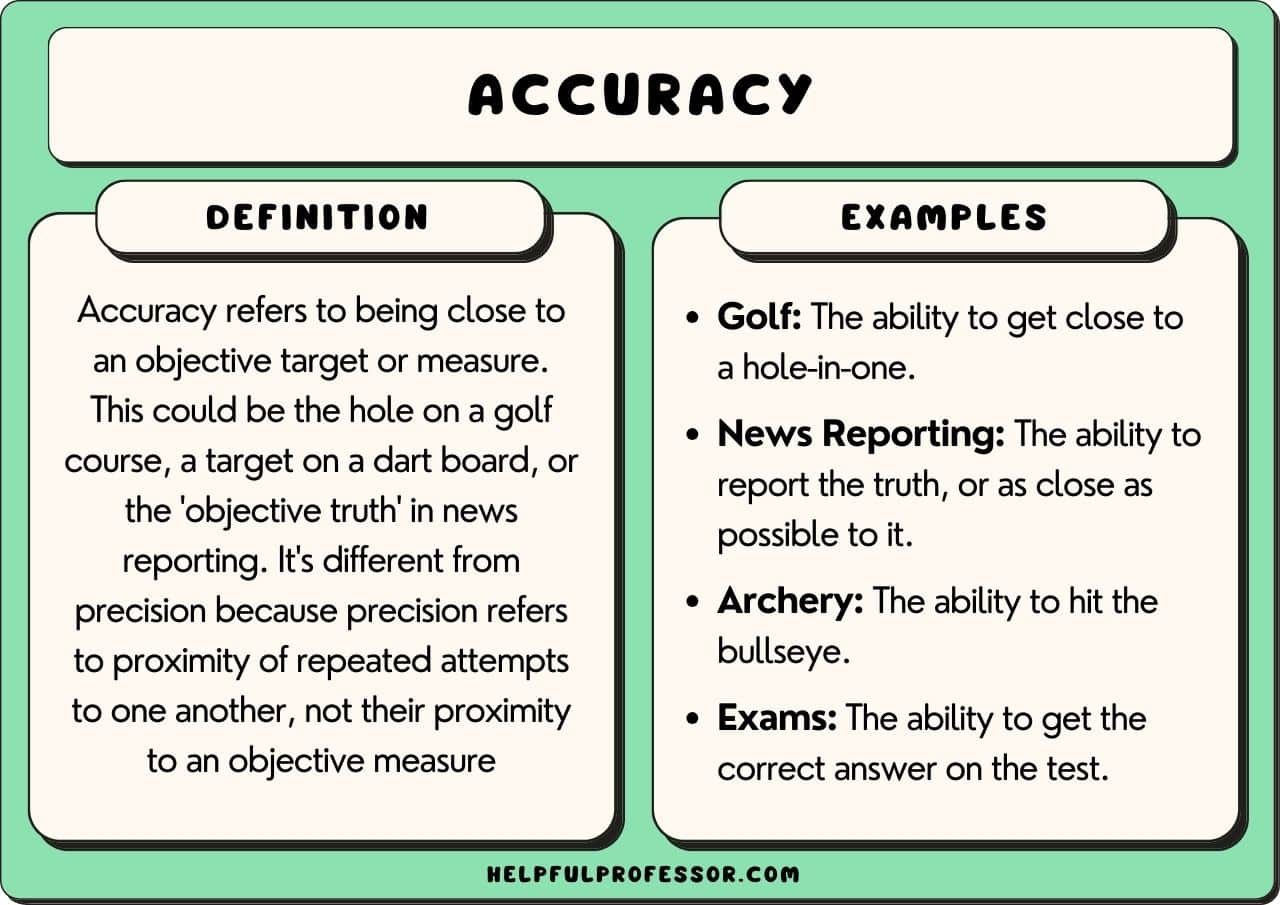
Accuracy refers to how close a measured value is to the true or accepted value. In other words, it measures the correctness of a measurement. For example, if you are aiming at a target with a bow and arrow, accuracy would mean hitting the bullseye consistently.
Precision
Precision, on the other hand, relates to how consistent repeated measurements are when taken under the same conditions. It focuses on the reproducibility or consistency of results. Using the bow and arrow example again, precision would mean hitting very close to each other but not necessarily near the bullseye.
Example:
Imagine a group of archers aiming at a target. Archer A consistently hits the outer ring of the target but all shots are clustered closely together. Archer B’s shots are scattered across the target but some hit closer to the bullseye.
- Archer A:
- Accuracy: Low (hits outer ring)
- Precision: High (shots clustered together)
- Archer B:
- Accuracy: Medium (some shots closer to bullseye)
- Precision: Low (shots scattered across target)
In conclusion, accuracy focuses on how close a measurement is to its true value, while precision looks at how consistent measurements are when taken repeatedly. Both accuracy and precision are crucial in various fields to ensure reliable results.
Understanding the Distinction: 8 Tips on Accuracy vs Precision with Examples
- Accuracy refers to how close a measurement is to the true value.
- If the actual temperature is 20°C and a thermometer reads 19.9°C, it is accurate.
- Precision indicates how close measurements are to each other, regardless of accuracy.
- High accuracy means results are near the true value.
- High precision means results are consistent with each other.
- ‘It is possible for measurements to be precise but not accurate.’
- An ideal measurement system achieves both high accuracy and high precision.
- A target shooter hitting near the bullseye consistently shows both qualities.
Accuracy refers to how close a measurement is to the true value.
In the realm of measurements, accuracy serves as a critical indicator of how closely a given value aligns with the true or accepted value. It signifies the degree of correctness in a measurement, highlighting the proximity of the result to the actual value being measured. For instance, in scientific experiments or engineering projects, achieving high accuracy ensures that the data collected or calculations made are reliable and trustworthy. This distinction between accuracy and precision underscores the importance of obtaining precise measurements that accurately reflect reality.
If the actual temperature is 20°C and a thermometer reads 19.9°C, it is accurate.
When discussing the concepts of accuracy and precision, it is important to understand their distinct meanings. In the context of temperature measurement, if the actual temperature is 20°C and a thermometer reads 19.9°C, we can consider it accurate. Accuracy in this scenario reflects how close the measured value is to the true value. Despite a slight deviation of 0.1°C, the measurement remains accurate as it aligns closely with the actual temperature. This example highlights the significance of accuracy in ensuring that measurements reflect reality with minimal error.
Precision indicates how close measurements are to each other, regardless of accuracy.
Precision is a key concept that highlights the consistency and reproducibility of measurements, independent of their accuracy. It signifies the degree of closeness between multiple measurements taken under the same conditions. For instance, in scientific experiments, precision plays a crucial role in determining the reliability and consistency of results by focusing on the repeatability of measurements. Achieving high precision ensures that data points are closely clustered together, even if they may not be accurate in relation to the true value being measured.
High accuracy means results are near the true value.
High accuracy indicates that the results are in close proximity to the true value being measured. In other words, when a measurement is highly accurate, it means that the data obtained is very reliable and aligns closely with the actual or accepted value. For instance, in a scientific experiment where the aim is to determine the weight of a substance, high accuracy would mean that the recorded weights are very close to the true weight of the substance. This emphasises the importance of accuracy in ensuring that conclusions drawn from data are trustworthy and valid.
High precision means results are consistent with each other.
High precision indicates that the results obtained from repeated measurements are consistent with each other. In other words, when a measurement is highly precise, it means that the values obtained are closely grouped and show little variability. For example, in scientific experiments, high precision would mean that if the same measurement is taken multiple times under the same conditions, the results would be very close to each other. This consistency in results demonstrates the reliability and reproducibility of the data, highlighting the importance of precision in obtaining accurate and trustworthy information.
‘It is possible for measurements to be precise but not accurate.’
It is important to understand that precision and accuracy are distinct concepts in measurement. One key point to remember is that it is possible for measurements to be precise but not accurate. This means that while the measurements may be consistently close to each other (precision), they may still be far from the true or target value (accuracy). For example, if a group of students consistently measures the length of a pencil and their results are very close to each other but significantly different from the actual length, their measurements would be considered precise but not accurate. This distinction highlights the need to consider both precision and accuracy when evaluating the reliability and validity of measurements.
An ideal measurement system achieves both high accuracy and high precision.
In the realm of measurements, an ideal system is one that strikes a delicate balance between high accuracy and high precision. Achieving both accuracy and precision ensures that the measured values are not only close to the true or accepted value but also consistently reproducible. Think of it as hitting the bullseye with every shot and having those shots tightly clustered together. This harmonious blend of accuracy and precision in a measurement system is essential for obtaining reliable and trustworthy results across various disciplines.
A target shooter hitting near the bullseye consistently shows both qualities.
A target shooter who consistently hits near the bullseye demonstrates both accuracy and precision. In this scenario, accuracy is showcased by the shooter’s ability to hit close to the intended target, which in this case is the bullseye. The precision is evident in the shooter’s consistent performance, with shots clustered closely together around the bullseye. This example perfectly illustrates how a combination of accuracy and precision can lead to exceptional results in target shooting, emphasising the importance of both qualities in achieving success in any endeavour.