
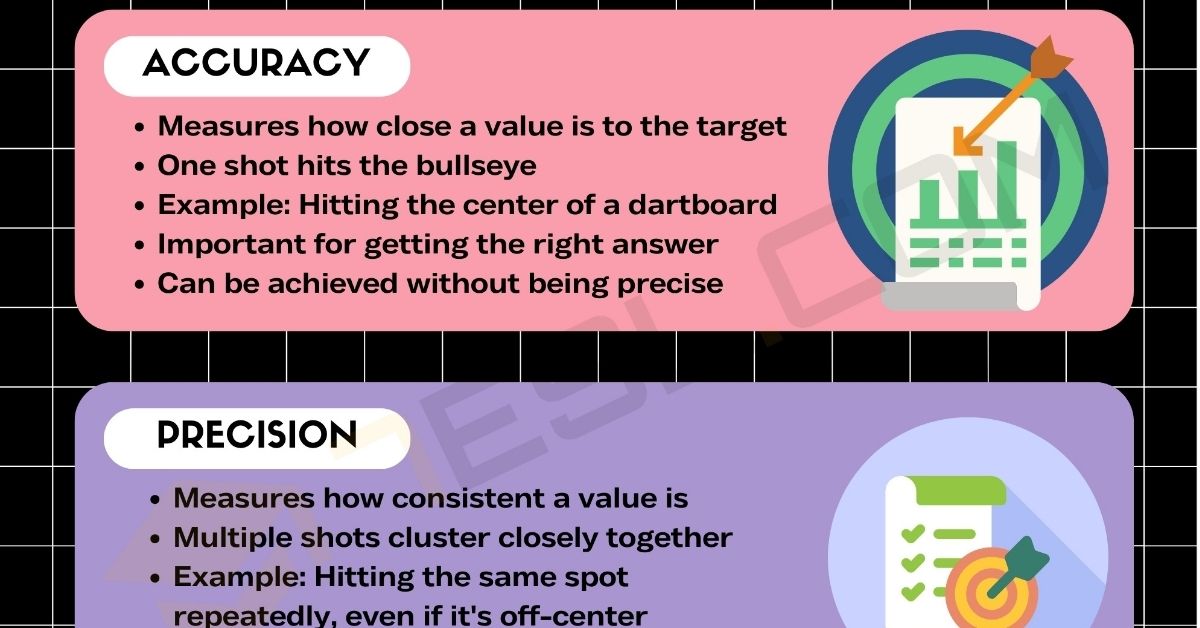
The Difference Between Precision and Accuracy
When it comes to measurements and data analysis, the terms precision and accuracy are often used interchangeably. However, they have distinct meanings that are important to understand.
Precision
Precision refers to the level of consistency and repeatability in measurements. A measurement is considered precise if repeated measurements under the same conditions yield similar results. In other words, precision is about how close the measured values are to each other.
Accuracy
Accuracy, on the other hand, relates to how close a measured value is to the true or accepted value. An accurate measurement is one that is close to the actual value being measured. It indicates how well a measurement reflects reality.
Key Differences
The key difference between precision and accuracy can be summarised as follows:
- Precision: Focuses on consistency and reproducibility of measurements.
- Accuracy: Focuses on how close a measurement is to the true value.
Importance in Science and Engineering
In scientific research, both precision and accuracy are crucial. A measurement may be precise but not accurate if it consistently misses the true value by the same amount. Conversely, a measurement may be accurate but not precise if it varies widely with each repetition.
To ensure reliable results, scientists and engineers strive for both precision and accuracy in their measurements. Understanding the difference between these two concepts helps in interpreting data correctly and making informed decisions based on reliable information.
Conclusion
In conclusion, precision and accuracy are distinct concepts that play a vital role in various fields, including science, engineering, healthcare, and more. By grasping the difference between these terms, we can enhance our understanding of measurements and ensure that our data is both reliable and meaningful.
Understanding Precision vs. Accuracy: Key Differences Explained Through Definitions, Examples, and Analogies
Definition
The distinction between precision and accuracy lies in their definitions within the context of measurements. Precision refers to the consistency and reproducibility of results, indicating how closely repeated measurements align with each other. On the other hand, accuracy pertains to how close a measured value is to the true or target value, reflecting the degree of correctness in the measurement. Understanding these definitions is crucial in various fields where precise and accurate data are essential for making informed decisions and drawing reliable conclusions.
Example
For example, consider a target shooting scenario where a skilled archer aims for the bullseye. If the archer consistently hits the same spot on the target but it is slightly off-centre from the bullseye, we would say that the archer’s shots are precise but not accurate. On the other hand, if the archer’s shots are clustered tightly around the bullseye, even if they are not hitting exactly the same spot each time, we would describe the shots as accurate but not necessarily precise. This distinction highlights how precision and accuracy can impact outcomes in practical situations requiring both consistency and closeness to a desired target.
Consistency
Consistency plays a crucial role in understanding the difference between precision and accuracy. In the context of measurements, consistency refers to the ability to produce similar results when the same measurement is repeated under identical conditions. A consistent set of measurements indicates precision, highlighting the reliability and reproducibility of the data. By maintaining consistency in measurement processes, researchers and professionals can enhance precision, leading to more accurate and trustworthy results in their work.
Error
When considering the distinction between precision and accuracy, it is essential to acknowledge the role of error in measurements. Error represents the discrepancy between a measured value and the true value being sought. Understanding and quantifying error is crucial in assessing the reliability and validity of data. While precision deals with the consistency of measurements, accuracy focuses on how close those measurements are to the actual value. By recognising and addressing errors effectively, researchers and practitioners can improve the quality of their results and make more informed decisions based on sound data analysis practices.
Target Analogy
In understanding the difference between precision and accuracy, a helpful analogy is the target analogy. Imagine a target board where hitting the bullseye represents the true value of a measurement. Accuracy would be hitting the bullseye consistently, indicating that the measured values are close to the actual value. Precision, on the other hand, would be hitting closely grouped shots on the target board, even if they are not near the bullseye. This analogy illustrates how accuracy relates to getting the right answer, while precision relates to getting consistent results, highlighting the distinct aspects of these two important concepts in measurements and data analysis.
Bullseye Analogy
In the realm of precision and accuracy, the bullseye analogy serves as a clear and effective way to distinguish between the two concepts. Imagine a target board where hitting the exact centre represents perfect accuracy. If multiple shots cluster tightly around the bullseye, it demonstrates high precision, regardless of whether they are close to the centre or not. This analogy highlights that precision is about consistency in hitting the same spot repeatedly, while accuracy is about how close those hits are to the desired target. By visualising this analogy, one can grasp the nuances between precision and accuracy more easily and apply this understanding to various measurement contexts.