
Define Accuracy and Precision
Accuracy and precision are two terms commonly used in the fields of science, engineering, and measurement. While they may seem similar, they have distinct meanings that are crucial for understanding the quality of data and measurements.
Accuracy
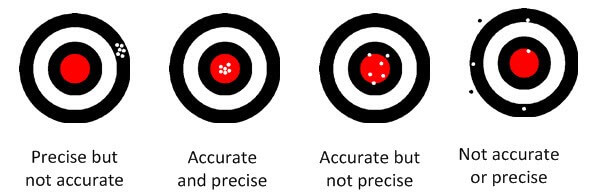
Accuracy refers to how close a measured value is to the true or accepted value. In other words, it measures the degree of correctness of a measurement compared to a standard or known value. A measurement is considered accurate if it is very close to the true value.
Precision
Precision, on the other hand, relates to the consistency or repeatability of measurements. It indicates how close multiple measurements are to each other when taken under the same conditions. A set of measurements is considered precise if they cluster closely together.
It is important to note that accuracy and precision are independent of each other. A measurement can be accurate but not precise, precise but not accurate, both accurate and precise, or neither accurate nor precise.
Key Differences
- Accuracy: Measures how close a measured value is to the true value.
- Precision: Indicates the consistency or repeatability of measurements.
- Relationship: Accuracy does not guarantee precision, and precision does not ensure accuracy.
- Importance: Both accuracy and precision are essential for obtaining reliable and trustworthy data in scientific experiments and measurements.
In conclusion, accuracy and precision play vital roles in determining the quality of measurements. Understanding these concepts can help researchers, scientists, engineers, and anyone involved in data collection to assess the reliability and validity of their results accurately.
Understanding Accuracy and Precision: Definitions and Examples Explained
- What is accuracy and precision with examples?
- Which means precision?
- What is the simple definition of precision?
- What is meant by accuracy and precision?
- What is accuracy and precision?
- What is the definition of accuracy?
What is accuracy and precision with examples?
Accuracy and precision are fundamental concepts in the realm of measurements and data analysis. Accuracy refers to how close a measured value is to the true or accepted value, indicating the degree of correctness in a measurement. For example, if a target is hit consistently near the bullseye on a dartboard, it demonstrates high accuracy. Precision, on the other hand, relates to the consistency and repeatability of measurements taken under the same conditions. An example of precision would be a marksman consistently hitting shots close together but not necessarily near the bullseye. Understanding these concepts is essential for ensuring reliable and trustworthy data in various fields where precise measurements are crucial for decision-making and analysis.
Which means precision?
Precision refers to the consistency and repeatability of measurements taken under the same conditions. In the context of accuracy and precision, precision specifically focuses on how closely individual measurements agree with each other. A high level of precision indicates that repeated measurements will yield very similar results, even if they are not necessarily close to the true value. Precision is crucial in scientific experiments and data analysis as it helps determine the reliability and reproducibility of results, providing valuable insights into the consistency of a measurement process.
What is the simple definition of precision?
When discussing precision in the context of measurements, it refers to the consistency and reproducibility of results obtained from repeated trials or observations. In simple terms, precision signifies how closely individual measurements agree with each other when conducted under the same conditions. It is a crucial aspect in assessing the reliability and trustworthiness of data, highlighting the degree of exactness and detail in obtaining consistent outcomes. Understanding precision helps ensure that measurements are not only accurate but also reliably reproducible, contributing to the overall quality and validity of scientific experiments and analyses.
What is meant by accuracy and precision?
The terms accuracy and precision are commonly used in various fields to describe the quality of measurements. Accuracy refers to how close a measured value is to the true or accepted value, indicating the correctness of a measurement compared to a standard reference. Precision, on the other hand, relates to the consistency or repeatability of measurements, highlighting how closely multiple measurements align with each other when conducted under similar conditions. Understanding the distinction between accuracy and precision is crucial for ensuring reliable and trustworthy data in scientific experiments, engineering practices, and measurement processes.
What is accuracy and precision?
Accuracy and precision are fundamental concepts in the realm of measurements and data analysis. Accuracy refers to how close a measured value is to the true or accepted value, indicating the correctness of a measurement. On the other hand, precision relates to the consistency and repeatability of measurements, showing how closely multiple measurements cluster together under the same conditions. Understanding the distinction between accuracy and precision is crucial for ensuring the reliability and validity of experimental results and data interpretations.
What is the definition of accuracy?
The definition of accuracy in the context of measurements refers to how closely a measured value aligns with the true or accepted value. It signifies the degree of correctness in a measurement, indicating how accurately the measured value reflects the actual quantity being measured. Achieving accuracy is essential in ensuring that data and results are reliable and trustworthy, particularly in scientific experiments, engineering applications, and various fields where precision is paramount for making informed decisions and drawing valid conclusions.