
The Difference Between Accurate and Precise Measurement
When it comes to measurements, accuracy and precision are two key concepts that are often confused but have distinct meanings.
Accurate Measurement
An accurate measurement refers to how close a measured value is to the true value or the target value. In other words, accuracy indicates the degree of closeness between the measured value and the actual value. For example, if a scale consistently reads 100 grams when an object truly weighs 100 grams, then it is considered accurate.
Precise Measurement
Precision, on the other hand, relates to the level of consistency or repeatability of measurements. A measurement is precise if repeated measurements under the same conditions yield similar results. Even if these results are far from the true value, they can still be precise if they cluster closely together. For instance, if a scale consistently reads 98 grams for an object that weighs 100 grams, then it is considered precise.
Key Differences
The main difference between accuracy and precision lies in their focus. Accuracy deals with how close a measurement is to the true value, while precision focuses on how consistent measurements are when repeated.
In summary, a measurement can be:
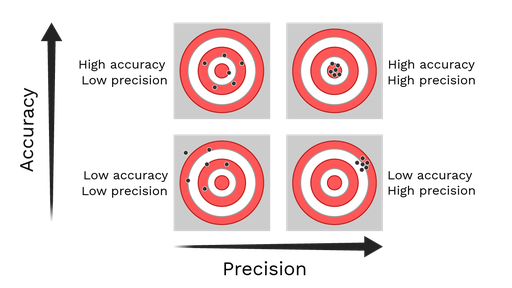
- Accurate but not precise: If measurements are consistently close to the true value but vary widely from each other.
- Precise but not accurate: If measurements cluster closely together but deviate significantly from the true value.
- Both accurate and precise: When measurements are both close to the true value and consistent with each other.
Understanding the distinction between accuracy and precision is crucial in various fields such as science, engineering, medicine, and manufacturing. By striving for both accuracy and precision in measurements, professionals can ensure reliable data and optimal outcomes in their work.
Understanding the Distinction: 5 Tips on Accuracy and Precision in Measurement
- Accuracy vs Precision
- Accuracy refers to how close a measurement is to the true value, while precision refers to how close repeated measurements are to each other.
- Accuracy can be affected by systematic errors, while precision can be affected by random errors.
- Improving accuracy involves reducing systematic errors, while improving precision involves reducing random errors.
- Using calibrated instruments and following standard procedures can help improve both accuracy and precision in measurements.
Accuracy vs Precision
Understanding the difference between accuracy and precision is essential for obtaining reliable measurements. Accuracy refers to how close a measured value is to the true or target value, while precision relates to the consistency and repeatability of measurements. Striving for both accuracy and precision ensures that measurements are not only close to the true value but also consistently reproducible. By grasping this distinction, professionals can enhance the quality and reliability of their data, leading to better decision-making and outcomes in various fields.
Accuracy refers to how close a measurement is to the true value, while precision refers to how close repeated measurements are to each other.
In the realm of measurement, it is essential to grasp the disparity between accuracy and precision. Accuracy pertains to the proximity of a measurement to the true value, indicating its reliability. On the other hand, precision focuses on the consistency and repeatability of measurements, highlighting how closely repeated measurements align with each other. Understanding this fundamental dissimilarity is pivotal in ensuring the reliability and validity of data across various disciplines where precision and accuracy are paramount.
Accuracy can be affected by systematic errors, while precision can be affected by random errors.
In the realm of measurement, it is important to recognise that accuracy and precision can be influenced by distinct types of errors. Accuracy may be impacted by systematic errors, which are consistent deviations from the true value due to flaws in measurement instruments or techniques. On the other hand, precision can be influenced by random errors, which introduce variability in measurements that are not consistent or predictable. Understanding these nuances is essential for practitioners to identify and address specific sources of error, thereby enhancing the reliability and quality of their measurements.
Improving accuracy involves reducing systematic errors, while improving precision involves reducing random errors.
Improving the accuracy of measurements entails addressing systematic errors, which are consistent deviations from the true value due to flaws in the measurement process or equipment. By identifying and rectifying these systematic errors, one can bring measured values closer to the actual value being measured. On the other hand, enhancing precision focuses on minimising random errors, which cause variability in measurement results when repeated under the same conditions. By reducing random errors through techniques like repeated measurements and calibration, one can achieve a higher level of consistency and repeatability in measurement outcomes. Balancing efforts to reduce both systematic and random errors is essential for obtaining measurements that are both accurate and precise.
Using calibrated instruments and following standard procedures can help improve both accuracy and precision in measurements.
Using calibrated instruments and following standard procedures can significantly enhance both accuracy and precision in measurements. Calibrated instruments ensure that measurements are aligned with known standards, reducing the likelihood of systematic errors. By adhering to standard procedures, consistency in measurement techniques is maintained, leading to more precise results. This combination of calibrated instruments and standard procedures not only improves the reliability of measurements but also increases confidence in the data obtained. Professionals across various industries rely on these practices to achieve accurate and precise results essential for informed decision-making and quality assurance.